1 Roosevelt Avenue, Suite 203 Peabody, MA 01960




Implant vs. Bridge Options Explained for Peabody Patients
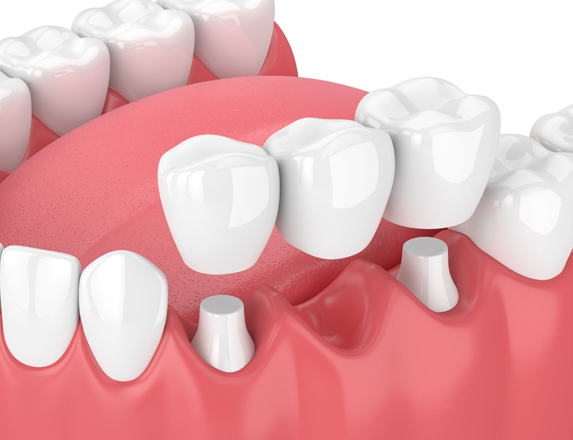
Losing a tooth, whether from decay, injury, or extraction, leaves more than just a gap in your smile. Over time, the surrounding teeth can shift, your bite can change, and the bone beneath the space begins to resorb. None of that happens overnight, but it does happen, and it’s exactly why replacing a missing tooth sooner rather than later matters.
The good news is that you have real options. Two of the most common tooth replacement solutions, dental implants and dental bridges, each have distinct advantages depending on your situation. Patients researching dental bridges often come in having already formed an opinion, only to find the consultation changes their thinking entirely.
This guide walks through both options honestly, side by side, so you can arrive at your consultation with better questions and a clearer sense of direction.
What Is a Dental Bridge, and How Does It Work?
A dental bridge is a fixed prosthetic that literally “bridges” the gap left by one or more missing teeth. It consists of one or more artificial teeth (called pontics) held in place by dental crowns cemented onto the natural teeth on either side of the gap. Those supporting teeth are called abutment teeth, and they’re prepared, meaning some enamel is removed, to accommodate the crowns.
For patients exploring dental bridges in Peabody, MA, the appeal is straightforward: no surgery, a relatively quick timeline (usually two to three appointments), and a result that looks and functions like natural teeth. Bridges have been used reliably for decades and, with proper care, can last 10 to 15 years or longer.
The trade-off worth knowing: preparing the abutment teeth requires permanently altering healthy tooth structure. It’s a well-established procedure, but it’s one that some patients, particularly younger ones with otherwise healthy teeth, prefer to avoid if possible.
What Is a Dental Implant, and How Is It Different?
A dental implant is a titanium post surgically placed into the jawbone, where it functions as an artificial tooth root. Once the implant fuses with the bone through a process called osseointegration, which takes anywhere from three to six months, a custom crown is attached on top.
The result is a standalone tooth replacement that doesn’t rely on neighboring teeth for support. It looks natural, functions like a real tooth, and critically stimulates the jawbone the way a natural tooth root would, preventing the bone loss that occurs beneath a bridge pontic.
Implant success rates are consistently high. According to a review published in the International Journal of Oral & Maxillofacial Implants, long-term implant survival rates exceed 95% over ten years in healthy patients. With proper maintenance, many implants last a lifetime.
The trade-off here is time and candidacy. Implants require surgery, sufficient jawbone volume, and a healing period before the final restoration is placed. Not every patient is an immediate candidate, though bone grafting can sometimes address insufficient bone density.
Implant vs. Bridge: A Side-by-Side Comparison
Both options effectively restore the look and function of a missing tooth. Where they diverge is in their approach, timeline, and long-term impact on your oral health.
Preservation of Neighboring Teeth
Implants win here. A bridge requires grinding down two adjacent healthy teeth to serve as anchors. An implant stands entirely on its own, leaving neighboring teeth completely untouched.
Bone Health
Again, implants have a structural advantage. Without a tooth root, the jawbone beneath a bridge gradually shrinks over time — a process called resorption. Implants mimic the root, stimulating the bone and preventing that loss.
Treatment Timeline
Bridges are faster. From preparation to final placement, a bridge typically takes a few weeks and two to three office visits. An implant requires several months to complete due to the osseointegration phase. For patients who need a quicker solution, this is a real consideration.
Longevity and Maintenance
Implants generally outlast bridges. While a well-maintained bridge lasts 10 to 15 years, implants routinely last 20 to 30 years or more, and in many cases, for life. Bridges also require more diligent cleaning beneath the pontic, where bacteria and plaque tend to accumulate. Implants are cleaned like natural teeth.
Surgical Requirements
Bridges don’t involve surgery, which makes them a more accessible option for patients who have medical conditions that complicate healing or who simply prefer to avoid an invasive procedure. Implants require surgery and sufficient bone volume, which not every patient has at the outset.
Which Option Is Right for You?
There’s no universal answer, and anyone who tells you otherwise without examining your mouth first isn’t giving you a straight answer. The right choice depends on your age, bone density, the health of adjacent teeth, your medical history, and, honestly, your personal priorities around timeline and longevity.
Generally speaking, implants tend to be the preferred long-term solution when a patient is a good candidate. But bridges remain a highly effective and clinically sound choice for many people – particularly those who need faster results, have bone loss concerns, or have two compromised teeth on either side of the gap that need crowns anyway.
Coastal Dental Arts serves patients across Peabody and the broader North Shore, including Danvers, Beverly, and Marblehead. During your consultation, Dr. Brzoza takes the time to review your full dental and medical history, take appropriate imaging, and talk through both options with complete transparency, including what each one involves financially, clinically, and in terms of your daily life.
Still Weighing Your Options? Let’s Talk.
The best tooth replacement is the one that fits your life — your health, your timeline, and your long-term goals. Dr. Brzoza at Coastal Dental Arts takes that seriously, which is why consultations here are conversations, not sales pitches.
Book your appointment with us or call the office today.
People Also Ask
Can a dental bridge be replaced with an implant later?
Yes, in many cases. If a bridge eventually fails or needs replacement, an implant is often a viable next step — provided there is adequate jawbone remaining. One of the reasons some dentists favor implants from the start is that prolonged bone loss beneath a bridge can eventually limit implant candidacy down the road. Early evaluation gives you more options.
Does getting a dental bridge hurt?
The preparation appointment involves local anesthesia, so the procedure itself is not painful. Some patients experience sensitivity in the abutment teeth for a few days after preparation, particularly to temperature. This typically resolves on its own. Once the permanent bridge is cemented, most patients adapt quickly and experience no ongoing discomfort.
How do I clean under a dental bridge?
Flossing under a bridge requires a floss threader or a water flosser to clean beneath the pontic, where a regular floss strand can’t reach directly. This step is important — food particles and plaque that accumulate under the bridge can cause decay in the abutment teeth or gum irritation. Your dental hygienist can demonstrate the technique at your next cleaning.
Is there an option that doesn’t involve surgery or altering healthy teeth?
A Maryland bridge (also called a resin-bonded bridge) is a more conservative alternative that attaches to the backs of adjacent teeth with metal or porcelain wings rather than full crowns. It’s generally used for front teeth replacements and in situations where the adjacent teeth are completely healthy. It’s not suitable for every case, but it’s worth asking about if preserving tooth structure is a priority.
Related Articles
Want to schedule an appointment?
Ready to book your next appointment? Let's find the perfect time for you!
